Contents
In a groundbreaking development that could revolutionize cardiac medicine, researchers have successfully 3D printed functional blood vessels for use in artificial heart tissue. This major advancement brings us one step closer to creating fully transplantable artificial hearts, potentially saving countless lives of patients awaiting donor organs.
Also Read-Lung Cancer Vaccine: World’s First Vaccine Trials Launched Across Seven Countries
The innovative technique, developed by a team of bioengineers at Harvard University, allows for the precise creation of complex vascular networks that closely mimic natural blood vessels found in human hearts. By combining cutting-edge 3D printing technology with novel biomaterials, the scientists have overcome one of the biggest hurdles in tissue engineering – providing adequate blood supply to artificially grown organs.
“This is a significant milestone in our quest to create fully functional artificial hearts,” said Dr. Jennifer Chen, lead researcher on the project. “The ability to 3D print blood vessels with such accuracy and functionality opens up exciting new possibilities in regenerative medicine and organ transplantation.”
The Breakthrough Technology in 3D Printing Blood Vessels.
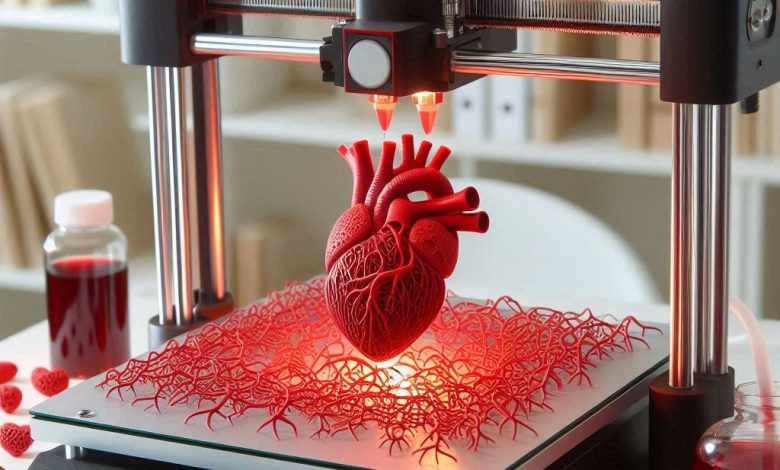
The new method utilizes a modified commercial 3D printer that has been specially adapted to work with biocompatible materials. The printer uses a unique “bio-ink” composed of living cells suspended in a gelatin-like substance. This allows for the creation of intricate vascular structures with multiple layers, closely replicating the architecture of natural blood vessels.
One of the key innovations is the printer’s ability to create branching networks of vessels, ranging from larger arteries down to tiny capillaries. This hierarchical structure is crucial for efficient blood flow and nutrient delivery throughout the tissue.
“Previous attempts at creating artificial blood vessels often resulted in simplistic, tube-like structures,” explained Dr. Chen. “Our method allows us to print vessels with realistic branching patterns and varying diameters, just like you’d find in a living heart.”
| Career/Professional Information | Details |
|---|---|
| Field of Study | Bioengineering, Tissue Engineering |
| Key Skills Required | 3D printing, Cell biology, Materials science |
| Average Salary (USA) | $92,620 per year (Biomedical Engineers) |
| Job Outlook (2022-2032) | 6% growth (As fast as average) |
| Related Careers | Medical Scientist, Materials Engineer |
The Path to Artificial Hearts.
The successful creation of 3D-printed blood vessels is a critical milestone in the journey towards developing fully functional artificial hearts. Here’s how this technology contributes to the larger goal:
- Vascular Network: The heart’s complex network of blood vessels can now be more accurately replicated, ensuring proper blood supply throughout the artificial organ.
- Customization: 3D printing allows for patient-specific designs, potentially improving the compatibility and performance of artificial hearts.
- Integration with Other Technologies: Combining 3D-printed blood vessels with advances in artificial muscle tissue and bioelectronics could lead to more sophisticated heart models.
- Reduced Rejection Risk: Using a patient’s own cells in the bioink could minimize the risk of immune rejection, a common issue in organ transplantation.
Despite these hurdles, the scientific community remains optimistic about the future of 3D-printed organs. Dr. Chen and her team are already working on the next phase of their research, which aims to incorporate the printed blood vessels into larger sections of functional heart tissue.
Implications for Heart Disease Treatment.
Heart disease remains the leading cause of death worldwide, with millions of patients suffering from conditions that could potentially benefit from this technology. The ability to create custom-designed, patient-specific blood vessels could dramatically improve outcomes for a wide range of cardiac procedures.
Dr. Michael Roberts, a cardiologist not involved in the study, commented on its potential impact: “This could be a game-changer for patients with severe heart damage. Imagine being able to simply ‘print’ new blood vessels to replace damaged ones, or even entire sections of heart tissue. It’s an exciting prospect.”
Some potential applications of this technology include:
- Repairing damaged heart tissue after a heart attack
- Creating patches for congenital heart defects
- Improving the success rate of bypass surgeries
- Testing new drugs on realistic 3D-printed heart tissue
Latest Studies in the Field.
Recent research has further highlighted the potential of 3D printing in cardiac medicine:
- A study published in the journal “Nature Biotechnology” demonstrated the successful implantation of 3D-printed cardiac patches in animal models, showing improved heart function after myocardial infarction.
- Researchers at MIT have developed a new bioink that allows for the simultaneous printing of multiple cell types, paving the way for more complex tissue structures.
- A team in Japan has reported success in creating 3D-printed blood vessels that can withstand the high pressures found in the human circulatory system, addressing a key challenge in artificial vessel design.
The Future of 3D Printed Organs.
As 3D printing technology continues to advance, its applications in medicine are expected to grow exponentially. Beyond cardiac tissue, researchers are exploring the potential for printing other organs such as livers, kidneys, and even neural tissue.
Dr. Sarah Thompson, a bioethicist specializing in emerging medical technologies, offered her perspective on the future of 3D-printed organs: “This technology has the potential to fundamentally change how we approach organ transplantation and regenerative medicine. However, it also raises important ethical questions that we as a society will need to grapple with.”
Some of the ethical considerations surrounding 3D-printed organs include:
- Equitable access to the technology
- Regulation and safety standards for engineered tissues
- The potential for human enhancement beyond medical necessity
- Implications for organ donation systems
As research in this field progresses, it will be crucial to address these ethical concerns alongside the scientific and medical advancements.
Challenges and Future Directions.
While the successful 3D printing of blood vessels represents a major breakthrough, several challenges must be overcome before the technology can be widely applied in clinical settings:
- Vascularization of larger tissues: Creating a network of blood vessels dense enough to support larger tissue structures remains a significant hurdle.
- Long-term functionality: Ensuring that printed blood vessels remain patent and functional over extended periods is crucial for their practical application.
- Integration with host tissue: Developing methods to seamlessly connect engineered vessels with the patient’s existing vasculature is essential for successful transplantation.
- Scalability and cost-effectiveness: Making the technology accessible and affordable for widespread use in healthcare systems worldwide.
- Regulatory approval: Navigating the complex landscape of medical device regulation and clinical trials to bring 3D-printed tissues to market.
Despite these challenges, researchers remain optimistic about the future of 3D-printed blood vessels and their potential to transform cardiac medicine. Ongoing collaborations between engineers, biologists, and clinicians are driving rapid progress in the field.
Conclusion.
The successful 3D printing of functional blood vessels marks a significant milestone in the quest to create artificial hearts and other organs. While there are still many obstacles to overcome, this breakthrough brings us one step closer to a future where custom-designed, patient-specific organs could be printed on demand, potentially saving countless lives.
As research in this field continues to advance, it holds the promise of revolutionizing transplant medicine and offering new hope to millions of patients worldwide suffering from heart disease and other organ failures.
FAQs.
Q1: How soon could 3D-printed blood vessels be used in human patients?
A1: While the technology is promising, it will likely take several years of further research and clinical trials before 3D-printed blood vessels can be used in human patients. Estimates range from 5-10 years, depending on the specific application and regulatory approval processes.
Q2: Could this technology eliminate the need for organ donors?
A2: While 3D printing of organs holds great promise, it’s unlikely to completely eliminate the need for organ donors in the near future. However, it could significantly reduce waiting times and improve outcomes for many patients awaiting transplants.
Q3: What are the main advantages of 3D-printed blood vessels over traditional grafts?
A3: 3D-printed vessels can be customized to patient-specific needs, potentially reducing the risk of rejection. They also offer the possibility of creating more complex vascular networks that closely mimic natural structures, potentially improving functionality and integration with host tissue.
Q4: Are there any risks associated with using 3D-printed blood vessels?
A4: As with any new medical technology, there are potential risks that need to be carefully studied. These could include immune rejection, mechanical failure, or unexpected long-term effects. Rigorous testing and clinical trials will be necessary to ensure safety before widespread use.
Q5: How does the cost of 3D-printed blood vessels compare to traditional treatments?
A5: Currently, the cost of producing 3D-printed tissues is relatively high due to the specialized equipment and materials required. However, as the technology advances and becomes more widespread, costs are expected to decrease, potentially making it a cost-effective alternative to some traditional treatments in the future.
Disclaimer
This article is for informational purposes only and does not constitute medical advice. The information provided about 3D printing of blood vessels and artificial heart tissue is based on current research and may change as new discoveries are made. Always consult with qualified healthcare professionals for medical advice and treatment options. The authors and publishers of this article are not responsible for any errors or omissions, or for any consequences arising from the use of the information presented herein.

Hi there!
I’m C.K. Gupta, the founder and head writer at FitnTip.com. With a passion for health and wellness, I created FitnTip to share practical, science-backed advice to help you achieve your fitness goals.
Over the years, I’ve curated valuable information from trusted resources on topics like nutrition, exercise, weight loss, and overall well-being. My aim is to distill this knowledge into easy-to-understand tips and strategies you can implement in your daily life.
Whether you’re looking to get in shape, eat healthier, or simply feel your best, FitnTip is here to support and guide you. I believe that everyone has the potential to transform their health through sustainable lifestyle changes.
When I’m not researching the latest health trends or writing for FitnTip, you can find me trying out new fitness routines, experimenting with nutritious recipes, and spending quality time with loved ones.
I’m excited to have you join our community as we embark on this wellness journey together. Let’s make positive, lasting changes and unlock a healthier, happier you!