Hydration Hacks: 7 Tips to Drink More Water Throughout the Day

It starts subtly. You feel a dull throb behind your eyes around 2:00 PM. Your focus drifts during a critical meeting. You find yourself re-reading the same email three times because the words just won’t stick. You might reach for a third cup of coffee or a sugary snack to push through the slump, but you are likely treating the wrong symptom.
You aren’t just tired. You are biologically parched.
Your brain is roughly 73% water. According to research from the National Institutes of Health (NIH), even mild dehydration—a loss of just 1-2% of your body mass—can lead to measurable cognitive decline. We are talking about reduced concentration, increased fatigue, impaired memory, and increased anxiety. When you starve your brain of fluids, it literally shrinks away from the skull. That headache? It’s often the physical manifestation of your brain pulling on the pain-sensitive meninges.
Also Read-Salt, Fat, and Sugar: Why the “Villains” of Nutrition Are Misunderstood
As the holistic health pioneer Paul Bragg famously noted, “Water is the key to all bodily functions, the distinct lubricant of your life.” It regulates your temperature, cushions your joints, and flushes waste. Yet, despite knowing this, most of us treat hydration as an afterthought. We wait until we are thirsty to drink, but by the time the thirst signal triggers, you are already in a deficit.
If you struggle to hit your daily quota because plain water feels like a chore, this guide is for you. We are moving beyond the generic “carry a water bottle” advice. Here are 7 scientifically backed, psychological hydration hacks to optimize your fluid intake without disrupting your busy life.

1. Eat Your Water: The “Gel Water” Strategy.
One of the biggest misconceptions about hydration is that it must come from a glass or a bottle. This binary thinking limits your options. You can—and should—eat a significant portion of your daily water requirements.
This concept, often referred to by anthropologists and nutritionists as consuming “gel water,” suggests that the water found in plants is actually more hydrating than the water from your tap. Why? Because water in fruits and vegetables is structured within the plant’s cells and bound to fibers, vitamins, and minerals. This structure allows for a slower, more sustained absorption rate.
When you chug a pint of plain water on an empty stomach, it passes through the digestive system rapidly, often leading to a quick trip to the bathroom. When you eat a cucumber, the water is released slowly as you digest the fiber, keeping you hydrated longer.
Top Water-Rich Foods to Add to Your Diet.

If you hate drinking water, try adding these “hydration bombs” to your plate:
- Cucumber (96% Water): The king of hydrating vegetables. It also contains silica, which is excellent for skin elasticity.
- Zucchini (95% Water): A versatile veggie that adds volume to meals without calories.
- Celery (95% Water): Provides a satisfying crunch and contains natural sodium, which helps retain fluids.
- Watermelon (92% Water): Packed with lycopene and antioxidants. It’s essentially an edible sports drink.
- Strawberries (91% Water): A low-sugar fruit option that adds flavor and fluid.
- Radishes (95% Water): These spicy roots are surprisingly full of fluid and add a kick to salads.
Pro Tip: Swap dry snacks for wet snacks. Instead of pretzels or crackers (which pull water out of your system for digestion), opt for carrot sticks with hummus or sliced bell peppers.
2. The “Habit Stacking” Method.
Relying on willpower to drink more water is a losing strategy. Willpower is a finite resource that depletes throughout the day as you make decisions at work. By the time you get home, your “discipline tank” is empty.
Instead, use a behavioral psychology technique popularized by BJ Fogg called “habit stacking.” The goal is to remove the decision-making process entirely. You anchor the new behavior (drinking water) to an established habit that is already hardwired into your brain.
The formula is: After [Current Habit], I will [Drink Water].
Implementation Examples:
The Bathroom Rule.
Every single time you use the restroom, commit to drinking one cup of water immediately after washing your hands. This creates a positive feedback loop: The more you drink, the more you use the restroom, and the more you drink again. It ensures you never go more than a few hours without fluids.
The Coffee Brew Protocol.
Most of us stand idly by while the coffee machine heats up or the kettle boils. Reclaim that “dead time.” While the coffee brews, drink one full 8oz glass of water. This rehydrates you from the night’s sleep before you introduce a diuretic (caffeine) into your system.
The Transition Trigger.
Use “transitions” as triggers. Just arrived at your desk? Drink. About to get in the car? Drink. Just finished a Zoom call? Drink. Associating the change of activity with a sip of water breaks up the day and keeps hydration top of mind.
3. Flavor Infusions (Skip the Powders).
Let’s be honest: Water can be boring. This “palate fatigue” is a major reason people reach for sodas or juices. However, commercial “water enhancers,” squirt bottles, and sports drinks are often loaded with artificial sweeteners (like sucralose or aspartame) or dyes (like Red 40).
You can hack your taste buds naturally. The goal is to make the water appetizing enough that you want to drink it, not just because you have to.
3 Chef-Approved Infusion Recipes.
Invest in a glass pitcher. Prep these in the morning, and the flavor will intensify by lunch.
- The “Spa Day” Standard: Cucumber ribbons, lemon slices, and fresh mint leaves. The lemon adds acidity to stimulate saliva, while cucumber provides a crisp finish.
- The Anti-Inflammatory Kick: Slices of fresh ginger root, turmeric, and orange slices. This is excellent for digestion and provides a warming sensation.
- The Berry Blast: Crushed raspberries (muddle them slightly with a spoon first) and lime wedges. This releases the juices and turns the water a vibrant, appetizing pink.
Why this works: The slight acidity from citrus fruits stimulates the salivary glands, making your mouth feel fresher and wetter than plain water does, which encourages you to keep drinking.
4. The “One-for-One” Rule.
If you enjoy a glass of wine with dinner or multiple coffees in the morning, you are fighting an uphill battle against your own biology. Alcohol and caffeine acts as diuretics. They suppress the release of vasopressin (also known as antidiuretic hormone or ADH).
Normally, ADH tells your kidneys to hold onto water. When you drink alcohol, ADH is suppressed, and your kidneys open the floodgates, dumping water into your bladder. This is why you dehydrate so quickly during happy hour.
The Protocol.
Adopt a strict, non-negotiable “One-for-One” rule.
For every caffeinated or alcoholic beverage you consume, you must match it with one glass of water.
This serves three distinct purposes:
- Harm Reduction: It immediately counteracts the diuretic effect, replenishing what you are about to lose.
- Pacing: It physically slows down your consumption. If you have to drink 8oz of water between beers, you will drink less alcohol overall.
- Habit Check: It forces you to be mindful of what you are consuming, rather than mindlessly sipping.
5. Visual Triggers & Environment Design.
Human beings are visual creatures. If something is out of sight, it is truly out of mind. If your water bottle is buried in your gym bag or left on the kitchen counter while you work in the study, you simply won’t drink enough.
This is a concept known as “reducing friction.” You want to make the desired habit (drinking) as easy as possible and the undesired habit (staying dehydrated) difficult.
Optimize Your Workspace.
Place a large carafe, a 32oz mason jar, or a high-capacity bottle directly in your line of sight on your desk. Ideally, it should be within arm’s reach so you don’t even have to break your focus or posture to grab it.

The Straw Hack: It sounds trivial, but many people find they drink significantly more water when using a straw. It lowers the effort required to tilt a bottle and allows for larger gulps. If you have a reusable tumbler, ensure it has a straw lid.
6. Tech-Assisted Hydration.
Sometimes, our biological thirst signals are subtle. We often confuse thirst for hunger, reaching for a snack when we actually need fluids. If you are a data-driven person who loves closing rings on an Apple Watch, let technology bridge the gap.
Smart Bottles.
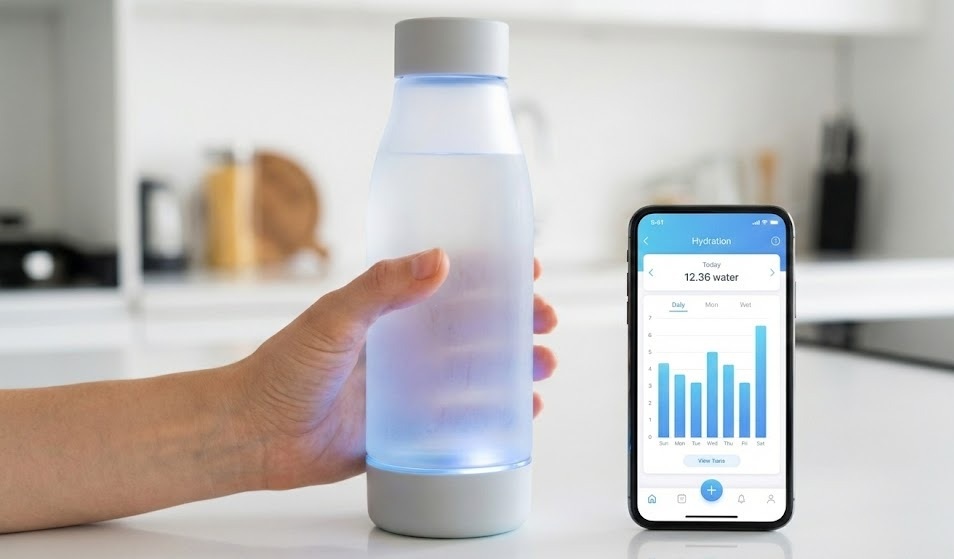
Hardware like the HidrateSpark uses Bluetooth sensors in the base of the bottle to weigh the water level. It tracks every sip you take and syncs it to your phone. If you fall behind your pace, the bottle literally glows on your desk to remind you. It’s a visual notification that is hard to ignore.
Apps & Gamification.
If a $60 smart bottle seems excessive, software works just as well. Apps like Waterllama, My Water, or Plant Nanny turn hydration into a game.
- Waterllama: Uses a fun, clean interface to log different drink types (accounting for the hydration level of coffee vs. water).
- Plant Nanny: A classic app where you water a virtual plant by drinking water in real life. If you don’t drink, your plant dies. It leverages our desire to nurture to keep us hydrated.
7. Electrolyte Awareness: When Water Isn’t Enough.
Have you ever chugged a liter of water after a workout but still felt thirsty, shaky, or had a headache? You might be suffering from a lack of electrolyte balance, not just a lack of fluids.
Hydration is not just about H2O; it is about the balance of fluids and minerals (sodium, potassium, magnesium, and calcium) that allow your cells to communicate. If you drink excessive amounts of plain water without replacing electrolytes—especially if you are sweating—you can dilute the sodium levels in your blood. In extreme cases, this leads to hyponatremia.
Who Needs Electrolytes?
- Heavy Sweaters: If you finish a workout and your shirt is soaked, or you see white salt streaks on your clothes.
- Keto/Low-Carb Dieters: Carbohydrates hold water and sodium in the body. When you cut carbs, your kidneys excrete sodium rapidly.
- The Morning After: If you consumed alcohol the night before, your electrolytes are likely depleted.
The Fix: You don’t need neon-colored sports drinks filled with sugar. A simple pinch of high-quality sea salt (like Celtic or Pink Himalayan) in your morning water can help absorption. Alternatively, use zero-sugar electrolyte packets tailored for athletes.
Comparing the Sources: Food vs. Fluid.
Understanding where your water comes from can help you plan your meals for maximum hydration. Here is a breakdown of common foods and their impact.
| Food Source | Water Content (%) | Nutritional Bonus | Best Way to Eat |
|---|---|---|---|
| Cucumber | ~96% | Vitamin K, Silica | Raw in salads or infused in water |
| Iceberg Lettuce | ~96% | Folate, Fiber | Wedge salad base |
| Celery | ~95% | Potassium, Sodium | With nut butter (adds healthy fat) |
| Tomatoes | ~94% | Lycopene, Vitamin C | Sliced with basil and mozzarella |
| Spinach | ~92% | Iron, Magnesium | Raw smoothies (cooking releases water) |
| Watermelon | ~92% | Vitamins A, B6, C | Cubed and chilled |
The Science: How Much Do You Actually Need?
For decades, we have been told to drink “8 glasses of 8 ounces” (the 8×8 rule). It is catchy, easy to remember, and unfortunately, not based on hard science. It likely originated from a 1945 Food and Nutrition Board recommendation that people stopped reading halfway through; the sentence actually continued to say that “most of this quantity is contained in prepared foods.
The Real Numbers.
The National Academies of Sciences, Engineering, and Medicine provides a more accurate Adequate Intake (AI) level for total water (including food and all beverages):
- Men: Approximately 15.5 cups (3.7 liters) per day.
- Women: Approximately 11.5 cups (2.7 liters) per day.
However, your “number” is a moving target. It shifts based on:
- Activity Level: Athletes need to replace sweat loss (weighing yourself before and after a run can calculate this).
- Climate: Hot or humid weather requires higher intake. Interestingly, high altitudes also increase fluid loss through respiration.
- Pregnancy/Breastfeeding: Requirements jump significantly to support the fetus and milk production.
The Urine Color Check: The Armstrong Chart.
Since you probably won’t measure every milliliter you drink, the most reliable feedback mechanism is your own biology. The “Pee Test” is a crude but effective tool. Doctors reference the Armstrong Scale to determine hydration status.
- Level 1-3 (Pale Straw / Transparent Yellow): Optimal. You are well-hydrated. Keep doing what you’re doing.
- Level 4-6 (Dark Yellow / Amber): Warning. You are mildly dehydrated. Your kidneys are concentrating urine to save water. Drink a glass immediately.
- Level 7-8 (Burnt Orange / Tea Colored): Danger. Severe dehydration. This can indicate a medical issue or extreme fluid loss. Rehydrate with electrolytes and water immediately.
Note: Certain vitamins (like B-Complex / Riboflavin) turn urine neon yellow. Be aware of your supplements when checking color.
Frequently Asked Questions (FAQs) on Daily Hydration.
How much water should I actually drink in a day?
Does drinking coffee count toward my daily water intake?
What are the earliest signs that I am dehydrated?
Can eating fruits and vegetables really replace drinking water?
What is the best way to remember to drink water if I’m busy?
Do I need electrolyte drinks if I am not an athlete?
What does the color of my urine indicate about my hydration?
Is sparkling water as effective as regular water for hydration?
Is it better to drink cold water or room temperature water?
Can drinking too much water be harmful?
Your 24-Hour Challenge.
Knowledge without action is useless. Hydration creates energy, and energy changes how you show up in the world. If you are tired of the brain fog, try this simple protocol tomorrow:
The “Wake Up & Water” Protocol:
- Tonight, fill a large glass or bottle and place it on your nightstand.
- Tomorrow morning, before you check Instagram, before you brush your teeth, and before you say a word to anyone—sit up and drink the entire thing.
You lose a significant amount of water simply by breathing while you sleep. This simple act kickstarts your metabolism, flushes out toxins accumulated overnight, and fires up your brain. Try it for one day. You will feel the difference.
Disclaimer: The information provided in this article and FAQ section is for educational purposes only and is based on general medical guidelines and scientific research. It is not intended to be a substitute for professional medical advice, diagnosis, or treatment. Always seek the advice of your physician or other qualified health provider with any questions you may have regarding a medical condition or specific hydration needs related to pregnancy, kidney issues, or other health concerns.
Trusted Sources & References.
We prioritize accuracy and evidence-based reporting. To ensure the validity of this article, we referenced the following scientific data and medical guidelines:
- The National Academies of Sciences, Engineering, and Medicine: Dietary Reference Intakes for Water and Electrolytes
- Mayo Clinic: Water: How much should you drink every day?
- Centers for Disease Control and Prevention (CDC): Get the Facts: Drinking Water and Intake
- National Institutes of Health (NIH) / NLM: Cognitive Performance and Hydration Status
- Harvard T.H. Chan School of Public Health: The Source of Hydration: Water Science
This article is for informational and educational purposes only. It does not constitute medical advice, diagnosis, or treatment. The information presented is researched from trusted sources including peer-reviewed scientific journals, CDC, NIH, WHO, and recognized health organizations. Always consult a qualified healthcare professional before making any changes to your diet, exercise routine, or health regimen.