The Science of Sleep: How to Create the Perfect Bedtime Routine

The statistics are staggering. According to the Centers for Disease Control and Prevention (CDC), insufficient sleep is now a public health epidemic. Approximately one in three adults fails to get the recommended seven hours of rest nightly. But the cost is not merely feeling tired the next day. The economic impact is colossal—the Rand Corporation estimates that sleep deprivation costs the U.S. economy over $411 billion annually in lost productivity.
On an individual level, the stakes are even higher. Chronic sleep deprivation is not just an annoyance; it is a carcinogen. It is directly linked to a higher risk of cardiovascular disease, type 2 diabetes, obesity, and Alzheimer’s disease. When you shorten your sleep, you shorten your lifespan.
Also Read-Hydration Hacks: 7 Tips to Drink More Water Throughout the Day
Yet, our cultural approach to sleep is fundamentally broken. We treat sleep as a tradable commodity—something we can barter for more work hours or late-night entertainment. When we do try to sleep, we often approach it with anxiety, trying to “force” ourselves unconscious. But biology does not negotiate. You cannot force sleep; you can only invite it.
Sleep is the single most effective thing we can do to reset our brain and body health each day.
— Matthew Walker, PhD, Professor of Neuroscience and Psychology at UC Berkeley
To fix your rest, you must stop relying on willpower and start relying on physiology. This comprehensive guide explores the science of sleep, dissecting the biological mechanisms that govern your nights, and provides a scientifically validated blueprint for the perfect bedtime routine.
Biological Mechanisms That Regulate Sleep.
To engineer a better night’s sleep, you first need to understand the machinery operating inside your brain. Two primary biological forces govern your wakefulness and sleepiness. When these two forces align, sleep is effortless. When they oppose each other, insomnia strikes.
1. Process S: Adenosine Accumulation.
Think of “Process S” like a hunger signal, but for sleep. It is driven by a chemical called adenosine.
Adenosine is a byproduct of energy consumption. Every minute you are awake, your neurons burn adenosine triphosphate (ATP) for energy. As ATP breaks down, adenosine molecules accumulate in the brain. They bind to specific receptors that slow down nerve cell activity, creating “sleep pressure.”
By the time you have been awake for 16 hours, the concentration of adenosine is high enough to trigger the overwhelming urge to sleep. While you sleep, the brain’s waste clearance system washes this adenosine away, resetting the pressure gauge for the next day.
How Caffeine Affects Adenosine: Caffeine acts as an adenosine-receptor antagonist. It does not reduce the level of adenosine; it simply blocks the receptors. It’s like putting tape over your car’s fuel gauge—you are still running out of gas (energy), but the signal is hidden. Once the caffeine is metabolized, the “tape” is ripped off, and all the accumulated adenosine hits your receptors simultaneously. This causes the infamous “afternoon crash.”
2. Process C: The Internal Body Clock.
While Process S measures how long you have been awake, Process C dictates when you should be awake. This is your internal 24-hour biological clock, located in a tiny region of the hypothalamus called the Suprachiasmatic Nucleus (SCN).
The SCN keeps time by monitoring external cues known as Zeitgebers (German for “time-givers”). The most powerful Zeitgeber is light. When sunlight hits the melanopsin ganglion cells in your retina, a signal travels to the SCN to halt the production of melatonin (the hormone of darkness) and increase the production of cortisol (the hormone of alertness).
The Sync Problem: In the modern world, we have decoupled from the solar day. We sit in dark offices during the day (reducing the wake signal) and stare at bright LED screens at night (suppressing the sleep signal). This creates a state of “social jetlag,” where your biological clock is perpetually out of sync with your actual schedule.
The Four Stages of the Sleep Cycle.
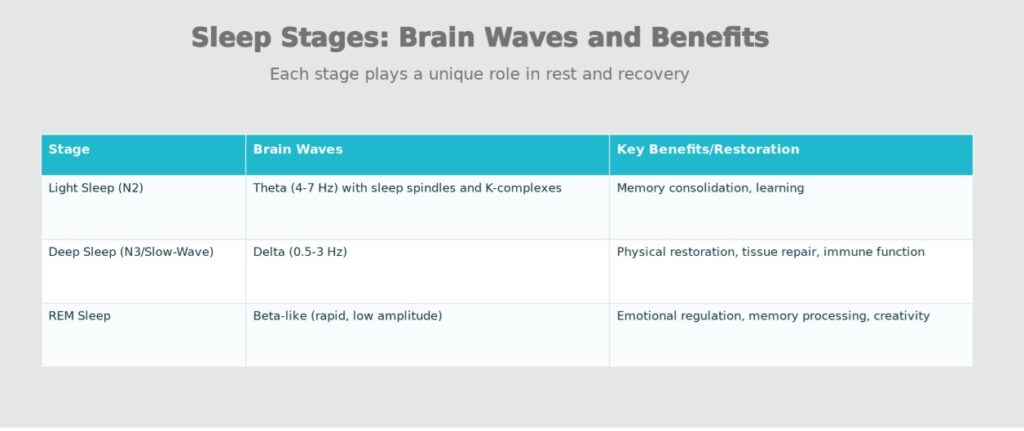
Sleep is not a monolith. It is a dynamic process where your brain cycles through four distinct stages roughly every 90 to 120 minutes. Each stage serves a critical physiological function. If you cut your sleep short, you don’t just lose “time”—you delete specific processes vital for mental and physical health.
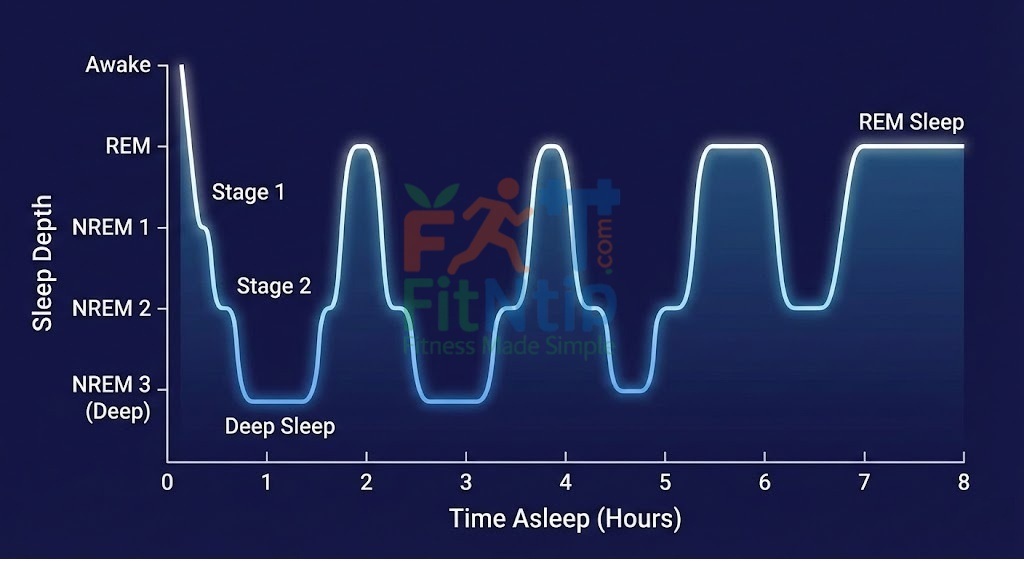
Stage 1: NREM 1 (Light Sleep Transition).
This is the lightest stage of Non-Rapid Eye Movement (NREM) sleep, lasting only 5 to 10 minutes. It acts as the transition zone between wakefulness and sleep. During this phase, your heartbeat and breathing slow, and muscles begin to relax. You might experience “hypnic jerks”—sudden muscle contractions accompanied by a sensation of falling. This is evolutionarily thought to be a reflex to prevent our ancestors from falling out of trees.
Stage 2: NREM 2 (Memory Processing).
You spend approximately 50% of your total sleep time in this stage. While considered “light sleep,” it is biologically active. Core body temperature drops, and the heart rate slows further. The defining characteristics of NREM 2 are Sleep Spindles and K-Complexes.
- Sleep Spindles: These are rapid bursts of brain activity that play a crucial role in transferring short-term memories from the hippocampus to the cortex for long-term storage.
- K-Complexes: These are high-voltage spikes of brain activity that act as a surveillance system. They suppress cortical arousal in response to external stimuli (like a partner moving or a distant siren) to keep you asleep.
Stage 3: NREM 3 (Deep Restoration).
This is the holy grail of physical restoration. Brain waves slow down to high-amplitude Delta waves. It is incredibly difficult to wake someone from this stage. This is when the magic happens:
- The Glymphatic System: During deep sleep, the glial cells in your brain shrink by up to 60%, allowing cerebrospinal fluid to wash through the brain tissue. This “power wash” removes metabolic waste products, including beta-amyloid plaques, which are linked to Alzheimer’s disease.
- Physical Repair: The pituitary gland releases the majority of your daily growth hormone pulsatile. This repairs muscle tissue, builds bone density, and strengthens the immune system.
Stage 4: REM Sleep (Emotional Regulation).
Rapid Eye Movement (REM) sleep is paradoxically active. Your brain activity mimics that of a waking state, but your voluntary muscles are paralyzed (atonia) to prevent you from acting out your dreams. REM is essential for:
- Emotional Regulation: The brain processes difficult emotional experiences from the day, stripping away the visceral anxiety so you can recall the memory without the pain.
- Creativity: The brain fuses disparate ideas, solving complex problems. This is the origin of the phrase “sleep on it.”
Common Causes of Sleep Disruption.
Before building the perfect routine, we must identify why standard attempts fail. It is rarely a lack of discipline; it is usually an environmental mismatch.
1. Revenge Bedtime Procrastination.
This psychological phenomenon is common among high-performers and parents. When you feel you have no control over your daytime hours due to work or family obligations, you rebel by staying up late to regain a sense of freedom. You scroll social media or watch TV not because you aren’t tired, but because you are desperate for “me time.” This spikes dopamine, which overrides the adenosine sleep pressure.
2. Blue Light Exposure at Night.
The photoreceptors in your eyes are most sensitive to short-wavelength light (blue spectrum) between 460-480 nanometers. This is exactly the spectrum emitted by smartphones, laptops, and LED house lights. A study published in Sleep Medicine Reviews confirms that exposure to this light within two hours of bed suppresses melatonin production by over 50%. By scrolling Instagram at 11:00 PM, you are chemically signalling your brain that the sun has just risen.
3. Orthosomnia (Obsession with Sleep Data).
With the rise of sleep trackers (Whoop, Oura, Apple Watch), a new disorder has emerged: Orthosomnia. This is the obsession with achieving “perfect” sleep data. The anxiety caused by a bad “sleep score” spikes cortisol, which in turn ruins the next night’s sleep, creating a self-fulfilling prophecy of insomnia.
The 10-3-2-1-0 Bedtime Routine Guide.
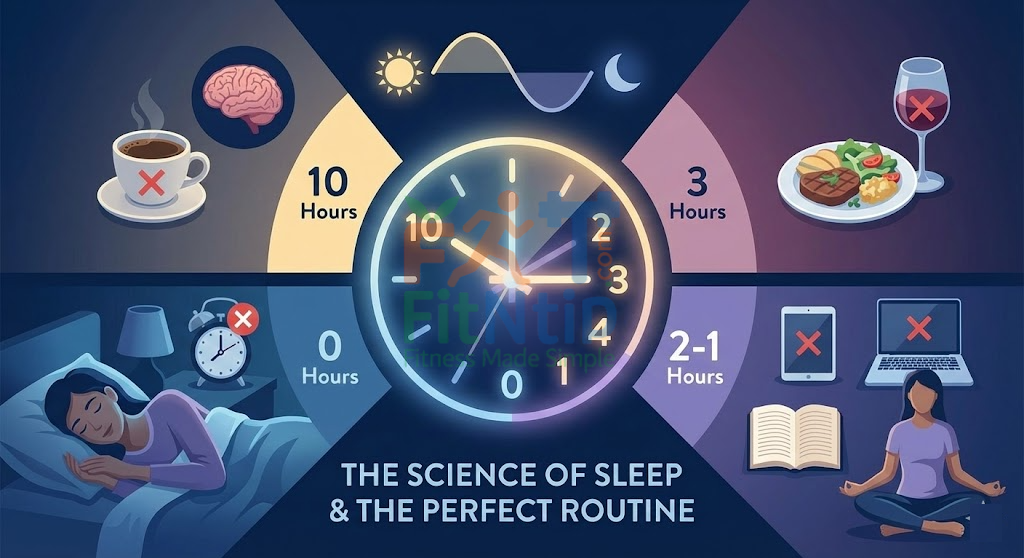
To optimize sleep, we need a structure that addresses both the chemical (hormonal) and psychological aspects of rest. The 10-3-2-1-0 rule is a countdown method used by elite athletes and executives to systematically power down the body.
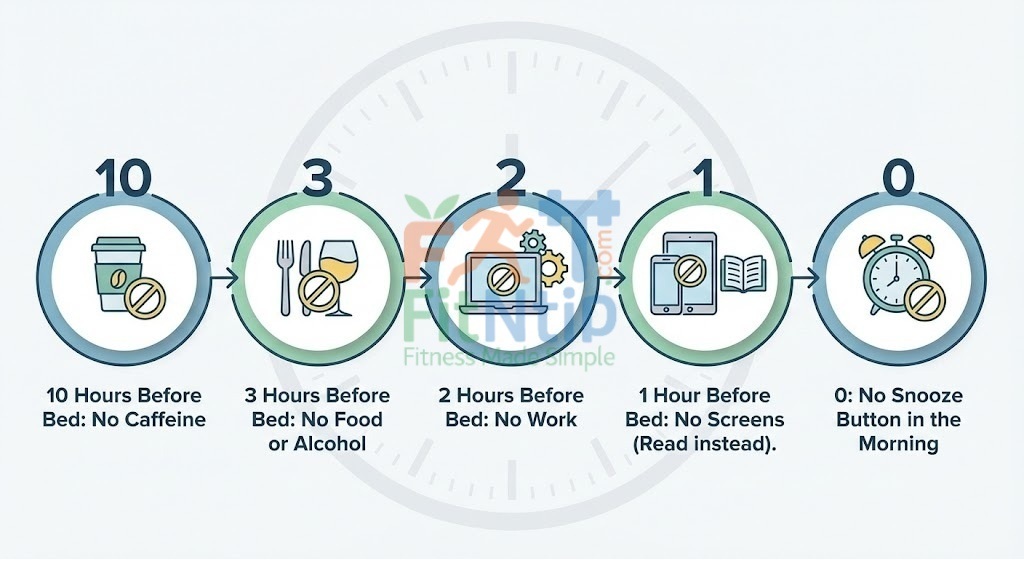
10 Hours Before Bed: Stop Caffeine Intake.
The half-life of caffeine varies by individual based on the CYP1A2 gene, but it averages 5 to 7 hours. This means if you consume 200mg of caffeine (a large coffee) at 4:00 PM, you still have 100mg active in your bloodstream at 10:00 PM. That is enough to block deep sleep generation. Even if you fall asleep, the caffeine will reduce the depth of your NREM 3 sleep, robbing you of physical restoration. Set a hard stop for caffeine at noon or roughly 10 hours before your target bedtime.
3 Hours Before Bed: Stop Eating and Drinking Alcohol.
Eating a large meal triggers digestion, a metabolically active process that raises your Core Body Temperature (CBT). To initiate sleep, your CBT must drop by approximately 2-3 degrees Fahrenheit. If your body is busy generating heat to digest a steak, you cannot achieve that temperature drop.
Why Alcohol Disrupts Sleep: Many people use alcohol as a “nightcap.” While alcohol is a sedative that helps you lose consciousness, it is not a sleep aid. It is a REM-blocker. It metabolizes into acetaldehyde, which fragments sleep and causes micro-awakenings throughout the night. Stop drinking 3 hours before bed to allow your liver to metabolize the alcohol before sleep onset.
2 Hours Before Bed: Stop Working.
This is the boundary for your mental health. Stop checking emails. Stop Slack. Stop planning tomorrow’s presentation. Work-related stimuli trigger the release of cortisol and norepinephrine—fight-or-flight chemicals. You need a buffer zone to shift your autonomic nervous system from the Sympathetic (alert) branch to the Parasympathetic (rest and digest) branch.
1 Hour Before Bed: Stop Using Screens.
This is the most difficult but most critical step. Remove all screens. This preserves your melatonin spike. If you must use a device, ensure it is set to “night shift” mode with maximum warmth, but ideally, you should switch to analog activities:
- Reading a physical book (fiction is better than non-fiction, as it engages the imagination rather than the planning brain).
- Meditation or breathwork.
- Light stretching.
0: Do Not Snooze the Alarm.
The “0” stands for zero times hitting the snooze button in the morning. If your alarm wakes you up, you are likely coming out of REM sleep. If you hit snooze and drift back off for 9 minutes, your brain attempts to restart a sleep cycle. When the alarm goes off again, you interrupt that new cycle, resulting in severe sleep inertia—a grogginess that can impair cognitive function for up to four hours.
How to Optimize Your Bedroom Environment.
Your willpower is finite; your environment is permanent. Change your bedroom, and your sleep will follow.
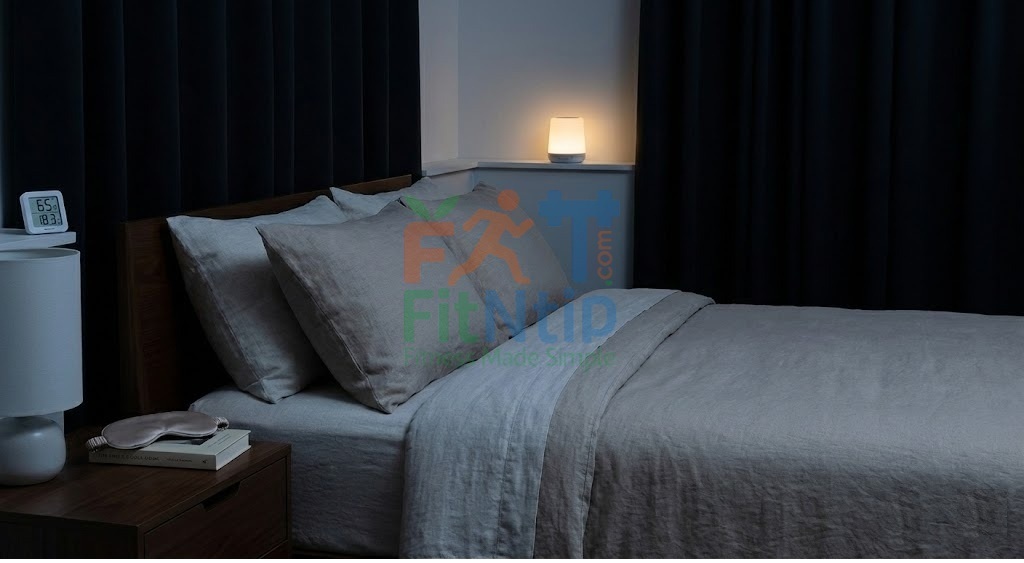
1. Lower the Temperature.
The National Sleep Foundation recommends a bedroom temperature between 60°F and 67°F (15°C – 19°C). A cool room mimics the natural drop in environmental temperature at night, signaling to the SCN that it is time to rest. If you cannot control the AC, use breathable bedding (percale cotton or linen) and consider a cooling mattress pad.
2. Block All Light Sources.
Your skin actually contains photoreceptors. Even small amounts of light from streetlamps or standby LEDs on televisions can degrade sleep quality.
The Fix: Install true blackout curtains. Use electrical tape to cover the small lights on smoke detectors or power strips. If you cannot make the room pitch black, wear a high-quality, convex eye mask that allows for eye movement without pressure.
3. Use Pink Noise for Sound Masking.
Sudden noises (a car door slamming) can trigger a “cortical arousal” even if they don’t fully wake you up.
The Fix: Use a sound machine to generate “Pink Noise.” Unlike White Noise (which sounds like static), Pink Noise (like heavy rain or wind) has a frequency that mimics brain waves during deep sleep and has been shown to improve memory consolidation in older adults.
Supplements and Diet for Better Sleep.
Disclaimer: This information is for educational purposes only. Always consult a physician before adding supplements to your routine, especially if you take other medications.
Recommended Supplements.
Avoid generic “sleeping pills” (like diphenhydramine) which are sedatives that cause grogginess. Instead, look for compounds that support the body’s natural relaxation pathways:
- Magnesium Bisglycinate (200-400mg): Magnesium is a cofactor in over 300 enzymatic processes. A double-blind, placebo-controlled trial published in the Journal of Research in Medical Sciences found that daily magnesium supplementation significantly improved sleep efficiency, sleep time, and renin levels in elderly subjects.
- L-Theanine (100-200mg): Found in green tea, this amino acid increases alpha brain waves, promoting a state of “relaxed alertness.” Research published in Pharmaceutical Biology suggests that L-Theanine promotes relaxation without causing drowsiness, helping to quiet the “racing mind” before bed.
- Apigenin (50mg): A bioflavonoid found in chamomile. A study in Molecular Medicine Reports identifies Apigenin as a ligand that binds to benzodiazepine receptors in the brain, offering anxiolytic (anxiety-reducing) effects that facilitate sleep onset.
Dietary Timing and Food Choices.
Avoid foods high in Tyramine (aged cheeses, cured meats, fermented soy) late at night, as tyramine triggers the release of norepinephrine, a brain stimulant. Conversely, a study in The American Journal of Clinical Nutrition revealed that consuming high-glycemic-index carbohydrates 4 hours before bedtime can significantly shorten sleep onset latency by increasing the availability of tryptophan.
Common Sleep Myths.
Myth 1: “I only need 5 hours of sleep.”
The Science: It is statistically improbable. There is a gene variant (DEC2) that allows for “Short Sleeping,” but it appears in less than 1% of the population. If you think you are in this group, you are likely just habituated to sleep deprivation. Researchers at the University of Pennsylvania found that after two weeks of six hours of sleep, subjects were as cognitively impaired as if they had stayed awake for 24 hours straight—yet they rated their sleepiness as “normal.” You lose the ability to judge your own impairment.
Myth 2: “I can catch up on sleep on the weekend.”
The Science: Sleep is not a bank. You cannot go into debt and pay it back later. A 2019 study in Current Biology showed that participants who restricted sleep during the week and “binge slept” on weekends still suffered from insulin sensitivity reduction and weight gain. Furthermore, shifting your wake-up time on weekends creates “Social Jetlag,” confusing your circadian rhythm for the following week.
Myth 3: “Waking up in the middle of the night is bad.”
The Science: Not necessarily. Historically, humans practiced “biphasic sleep”—two segments of sleep separated by an hour of quiet wakefulness. Waking up is normal as you transition between sleep cycles. The problem arises when you react to the awakening with anxiety. If you wake up, stay calm, keep the lights off, and rest. You are likely still in a rest state.
Sleep is not a passive activity where you simply “turn off.” It is a complex, metabolically active state required for emotional stability, physical repair, and cognitive function. In a world that glorifies “the grind,” prioritizing sleep is an act of rebellion.
You do not need to implement every strategy in this article tonight. Start with the foundation:
- Light: Get morning sun; avoid evening screens.
- Darkness: Make your room a cave.
- Temperature: Keep it cool.
- Routine: Follow the 10-3-2-1-0 countdown.
Sleep is the foundation upon which diet and exercise sit. If the foundation is cracked, the house will fall. Respect the biology, and your body will reward you with energy, focus, and health.
Frequently Asked Questions (FAQs) on The Science of Sleep.
What is the 10-3-2-1-0 rule for sleep?
Why is blue light bad for sleep?
Can I catch up on missed sleep on the weekend?
What is the best temperature for sleeping?
How long does caffeine stay in your system?
What are the 4 stages of sleep?
Does alcohol help you sleep better?
{
“@context”: “https://schema.org”,
“@type”: “FAQPage”,
“mainEntity”: [
{
“@type”: “Question”,
“name”: “What is the 10-3-2-1-0 rule for sleep?”,
“acceptedAnswer”: {
“@type”: “Answer”,
“text”: “The 10-3-2-1-0 rule is a countdown method to optimize your bedtime routine: 10 hours before bed, stop caffeine; 3 hours before, stop food and alcohol; 2 hours before, stop working; 1 hour before, stop screen time; and 0 times hitting the snooze button in the morning.”
}
},
{
“@type”: “Question”,
“name”: “Why is blue light bad for sleep?”,
“acceptedAnswer”: {
“@type”: “Answer”,
“text”: “Blue light (emitted by phones and laptops) suppresses the production of melatonin, the hormone that signals your body to sleep. Studies show that exposure to blue light within two hours of bedtime can delay sleep onset and reduce sleep quality by tricking your brain into thinking it is still daytime.”
}
},
{
“@type”: “Question”,
“name”: “Can I catch up on missed sleep on the weekend?”,
“acceptedAnswer”: {
“@type”: “Answer”,
“text”: “No, you cannot effectively ‘bank’ sleep. Research published in Current Biology indicates that ‘binge sleeping’ on weekends does not reverse the metabolic damage (such as insulin resistance) caused by sleep deprivation during the week. It also disrupts your circadian rhythm, leading to ‘Social Jetlag.'”
}
},
{
“@type”: “Question”,
“name”: “What is the best temperature for sleeping?”,
“acceptedAnswer”: {
“@type”: “Answer”,
“text”: “The ideal bedroom temperature for optimal sleep is between 60°F and 67°F (15°C – 19°C). Your core body temperature needs to drop by about 2°F to initiate and maintain deep sleep. A room that is too warm can block this process and cause wakefulness.”
}
},
{
“@type”: “Question”,
“name”: “How long does caffeine stay in your system?”,
“acceptedAnswer”: {
“@type”: “Answer”,
“text”: “Caffeine has a half-life of approximately 5 to 7 hours. This means if you drink a coffee at 4:00 PM, half of that caffeine is still active in your brain at 10:00 PM, which can block adenosine receptors and prevent deep sleep.”
}
},
{
“@type”: “Question”,
“name”: “What are the 4 stages of sleep?”,
“acceptedAnswer”: {
“@type”: “Answer”,
“text”: “The sleep cycle consists of: Stage 1 (NREM 1), the transition to sleep; Stage 2 (NREM 2), light sleep where memory consolidation begins; Stage 3 (NREM 3), deep restorative sleep for physical repair; and Stage 4 (REM), where dreaming and emotional processing occur.”
}
},
{
“@type”: “Question”,
“name”: “Does alcohol help you sleep better?”,
“acceptedAnswer”: {
“@type”: “Answer”,
“text”: “No. While alcohol is a sedative that may help you fall asleep faster, it drastically reduces sleep quality. It blocks REM sleep (dream sleep) and causes sleep fragmentation, meaning you wake up frequently during the night, often without realizing it, leaving you unrefreshed the next day.”
}
}
]
}
Trusted Authorities & Scientific References
We believe in transparency. This article draws upon peer-reviewed research and data from the following institutions:
This article is for informational and educational purposes only. It does not constitute medical advice, diagnosis, or treatment. The information presented is researched from trusted sources including peer-reviewed scientific journals, CDC, NIH, WHO, and recognized health organizations. Always consult a qualified healthcare professional before making any changes to your diet, exercise routine, or health regimen.