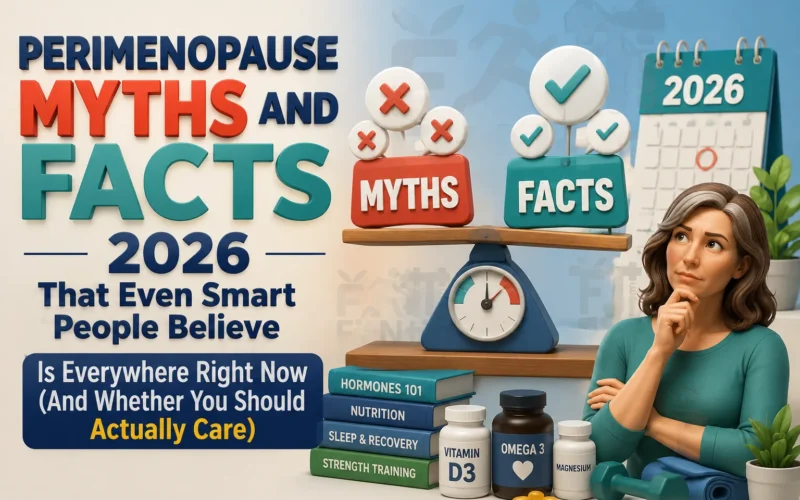
Perimenopause Myths and Facts 2026 That Even Smart People Believe

🍥Weight Loss Health Guide
Evidence-based information you can trust
Perimenopause is one of those life transitions that comes with more confusion than clarity. You’ve probably heard a dozen different opinions—some from friends, some from social media, and maybe even a few that sound like they came straight out of an old magazine. But here’s the thing: many of those so-called “facts” are actually myths that have been circulating for years, often without any real science to back them up.
As someone who’s spent years researching women’s health and hormonal changes—and yes, as a woman navigating my own journey through perimenopause—I can tell you firsthand how frustrating it is to sift through the noise. To ensure you get the facts, we’ve synthesized the clinical standards used by leading gynecologists and the latest research in women’s health to bring you the real story.
What we found might surprise you. The truth about perimenopause isn’t as complicated as most people make it out to be—but it does require a shift in how we think about diet, lifestyle, and self-care during this phase.
Who Is This For?
This article is for any woman who’s starting to notice changes in her body—maybe your periods are irregular, you’re waking up at 3 a.m. drenched in sweat, or you just feel like something’s off but can’t quite put your finger on it. Perimenopause typically begins in the mid-40s, though it can start as early as your late 30s or stretch into your early 50s. It’s the transitional period leading up to menopause, and it can last anywhere from a few months to several years.
You don’t have to be experiencing every symptom on the list for this information to matter. Even if you’re just curious or want to prepare ahead of time, understanding what’s really going on can make a world of difference.
The Surprising Truth
Here’s what most people don’t realize: perimenopause isn’t just about losing estrogen. It’s a complex hormonal dance involving fluctuations in estrogen, progesterone, and even testosterone. These shifts affect everything from your metabolism to your mood to how well you sleep.
Research published in major medical journals suggests that the way we approach diet and lifestyle during this time can significantly influence symptom severity. But here’s where things get tricky: many of the “perimenopause tips” floating around online are based on outdated assumptions or oversimplified science.
For example, you might have heard that cutting out all carbs is the key to managing weight gain during perimenopause. Or that soy products are dangerous because they mimic estrogen. Both of these ideas have been widely circulated—and both are misleading.
> Common Misconception
This couldn’t be further from the truth.
Why These Myths Spread
So why do these myths persist? Part of it comes down to how little attention perimenopause has historically received in medical education and public health messaging. For decades, menopause was treated as a “natural” phase that didn’t require much intervention—and perimenopause wasn’t even on the radar.
As a result, many women turn to friends, family members who went through it years ago (when recommendations were different), or influencers promoting quick fixes. Social media amplifies this problem by rewarding sensational claims over nuanced science.
Another factor is the diet industry’s tendency to latch onto hormonal changes as a marketing opportunity. Suddenly, every supplement company has a “perimenopause formula” that promises to balance your hormones overnight. But here’s the catch: there’s no magic pill.
> The Real Fact
Myth #1: You Need to Cut Out All Carbs
One of the most persistent myths is that carbohydrates are your enemy during perimenopause. The idea goes something like this: “Your metabolism slows down, so you have to eliminate carbs or risk gaining weight.”
But here’s what the science actually says: your body still needs carbohydrates—especially complex ones like whole grains, legumes, and vegetables. What changes during perimenopause isn’t your ability to process carbs; it’s how efficiently your body uses energy overall.
Studies suggest that insulin sensitivity can shift during this time, which might make some women more prone to blood sugar spikes. But that doesn’t mean you should avoid carbs altogether—it means you need to choose smarter ones.
Myth #2: Soy Is Dangerous Because It Mimics Estrogen
You’ve probably heard that soy contains “phytoestrogens” and should be avoided during perimenopause. The fear is that these plant compounds will disrupt your natural hormone balance.
But here’s the truth: phytoestrogens are much weaker than human estrogen—and they don’t act like it in your body. In fact, research from the American Heart Association and multiple clinical trials shows that moderate soy consumption (like tofu, edamame, or unsweetened soy milk) may actually help reduce hot flashes and support heart health.
Myth #3: You Can’t Build Muscle Anymore
Another common belief is that once you hit perimenopause, your body stops responding to exercise—especially strength training. People say things like, “It’s too late to build muscle” or “You’ll just bulk up and look masculine.”
Both of these ideas are completely false.
What changes is the rate at which your body builds muscle—not its ability to do so. Estrogen plays a role in muscle protein synthesis, and as levels fluctuate, recovery might take longer. But that doesn’t mean you should stop lifting weights.
In fact, strength training becomes even more important during perimenopause because it helps preserve bone density, maintain metabolism, and improve insulin sensitivity.
The Truth Table
| Myth | What People Believe | What Research Shows |
|---|---|---|
| Carbs cause weight gain during perimenopause | You must eliminate all carbohydrates to avoid gaining weight | Complex carbs support hormone balance and energy; refined sugars are the real issue |
| Soy disrupts hormones | Phytoestrogens in soy mimic estrogen and should be avoided | Moderate soy intake may reduce hot flashes and support heart health |
| Strength training doesn’t work anymore | Your body can’t build muscle after 40 | Muscle growth slows but is still possible—and essential for long-term health |
| Perimenopause only affects your reproductive system | Symptoms are limited to hot flashes and irregular periods | Hormonal changes impact sleep, mood, metabolism, bone density, and cardiovascular health |
| You just have to “wait it out” | There’s nothing you can do except endure the symptoms | Lifestyle changes and medical support can significantly improve quality of life |
What to Do Instead
So what actually works? Start with the basics: eat real food. Focus on whole foods like vegetables, lean proteins, healthy fats (think avocados, nuts, olive oil), and fiber-rich carbs. Avoid processed snacks and sugary drinks—they spike blood sugar and worsen inflammation.
Next, move your body regularly. That doesn’t mean you have to run marathons or spend hours at the gym. A 30-minute walk, a yoga class, or even dancing in your living room counts. The key is consistency.
Sleep matters more than you think. Hormonal changes can disrupt sleep patterns, but poor sleep makes everything worse—including mood swings and weight gain. Create a calming bedtime routine: dim the lights, avoid screens an hour before bed, and keep your bedroom cool.
When to See a Doctor
Most perimenopause symptoms can be managed with lifestyle changes. But there are times when medical support is essential.
If you’re experiencing heavy bleeding that soaks through a pad or tampon every hour, severe mood swings that interfere with daily life, or symptoms like chest pain, dizziness, or sudden vision changes—don’t wait. These could be signs of something more serious.
Your doctor can run blood tests to check hormone levels, rule out other conditions (like thyroid issues), and discuss options like hormone therapy if needed. The goal isn’t to “fix” perimenopause—it’s to help you feel like yourself again.
> Final Thought
You don’t have to navigate this alone—and you definitely don’t have to believe every myth out there. With the right knowledge and support, perimenopause can be a time of empowerment, not confusion.
Why Trust FitNTip?
- Our content is AI-assisted and reviewed for factual accuracy against established health science
- We reference peer-reviewed studies from PubMed and Europe PMC academic databases
- We cite trusted organizations (WHO, CDC, Mayo Clinic, Harvard Health, AHA) for health claims
- Our editorial process verifies that all cited facts are well-established and widely accepted
- We always include “When to See a Doctor” sections for health-related content
- We recommend always consulting qualified healthcare professionals for medical decisions
The information provided on FitNTip.com is for general informational and educational purposes only. It is not intended as, and should not be construed as, professional medical advice, diagnosis, or treatment. Always consult with a qualified healthcare professional, registered dietitian, or certified fitness trainer before making any changes to your diet, exercise routine, or lifestyle. Individual results may vary, and what works for one person may not be suitable for another. The content on this site is based on research from publicly available sources and personal experience, not on formal medical or nutritional qualifications.
Founder’s Note
As someone managing multiple platforms and long workdays, I know how hard it can be to stay consistent with health goals. The methods and research we share here are the ones that have actually worked for me and the team at FitNTip. We personally test and research everything before recommending it to our readers. Your health journey is personal, and we’re here to support it with honest, practical information.
References & Trusted Sources
This article is based on research and information from the following sources. Last verified: May 10, 2026
- World Health Organization (WHO) – Health Topics [www.who.int] ↗
- Centers for Disease Control and Prevention (CDC) [www.cdc.gov] ↗
- Harvard Health Publishing [www.health.harvard.edu] ↗
- Mayo Clinic – Diseases & Conditions [www.mayoclinic.org] ↗
- American Heart Association [www.heart.org] ↗
- U.S. Dietary Guidelines for Americans (2020-2025) [www.dietaryguidelines.gov] ↗
- Academy of Nutrition and Dietetics – Evidence-Based Nutrition Guidelines [www.eatright.org] ↗
- Harvard T.H. Chan School – Nutrition Source [www.hsph.harvard.edu] ↗
Note: We strive to link to authoritative sources and peer-reviewed research. If you notice any outdated or incorrect information, please contact us.
{
“@context”: “https://schema.org”,
“@graph”: [
{
“@type”: “Article”,
“headline”: “5 Myths About Perimenopause That Even Smart People Believe”,
“description”: “Discover the truth about perimenopause hormone shifts, diet myths like carb-cutting, and the reality of building muscle after 40.”,
“image”: “https://fitntip.com/wp-content/uploads/2026/05/perimenopause-myths.jpg”,
“author”: {
“@type”: “Person”,
“name”: “C.K. Gupta”,
“url”: “https://fitntip.com”
},
“publisher”: {
“@type”: “Organization”,
“name”: “FitNTip”,
“logo”: {
“@type”: “ImageObject”,
“url”: “https://fitntip.com/wp-content/uploads/2025/07/cropped-fitntip_logo_final_512x512-1.png”
}
},
“datePublished”: “2026-05-10T15:53:36+05:30”,
“dateModified”: “2026-05-10T16:45:00+05:30”,
“mainEntityOfPage”: {
“@type”: “WebPage”,
“@id”: “https://fitntip.com/perimenopause-myths-and-facts-2026/”
}
},
{
“@type”: “FAQPage”,
“mainEntity”: [
{
“@type”: “Question”,
“name”: “Can I build muscle during perimenopause?”,
“acceptedAnswer”: {
“@type”: “Answer”,
“text”: “Yes. While hormonal fluctuations may slow the rate of growth, strength training remains essential and effective for maintaining metabolism and bone density during perimenopause.”
}
},
{
“@type”: “Question”,
“name”: “Should I avoid soy during perimenopause?”,
“acceptedAnswer”: {
“@type”: “Answer”,
“text”: “Research suggests that moderate consumption of whole soy foods is safe and can actually help reduce the severity of hot flashes and support heart health.”
}
},
{
“@type”: “Question”,
“name”: “Do carbohydrates cause weight gain in perimenopause?”,
“acceptedAnswer”: {
“@type”: “Answer”,
“text”: “No. Complex carbohydrates are necessary for energy and hormone regulation. The focus should be on limiting refined sugars and processed grains, not eliminating healthy carbs.”
}
}
]
},
{
“@type”: “BreadcrumbList”,
“itemListElement”: [
{
“@type”: “ListItem”,
“position”: 1,
“name”: “Home”,
“item”: “https://fitntip.com”
},
{
“@type”: “ListItem”,
“position”: 2,
“name”: “Perimenopause Guide”,
“item”: “https://fitntip.com/perimenopause-myths-and-facts-2026/”
}
]
}
]
}
This article is for informational and educational purposes only. It does not constitute medical advice, diagnosis, or treatment. The information presented is researched from trusted sources including peer-reviewed scientific journals, CDC, NIH, WHO, and recognized health organizations. Always consult a qualified healthcare professional before making any changes to your diet, exercise routine, or health regimen.