
Grip Strength: What Research Says About the Longevity Marker That Matters in 2027

Quick Answer
Grip strength is how hard you can squeeze a hand dynamometer, measured in kilograms. It takes about 30 seconds, costs almost nothing, and needs no lab — yet it is one of the most replicated predictors of how long people live. Across three independent bodies of evidence, each 5 kg lower grip strength was linked to about 16% higher mortality during follow-up: the PURE study of 139,691 adults in 17 countries, UK Biobank’s half a million adults, and a meta-analysis of 42 cohorts covering 3 million people all landed on the same figure.
The number is a window, not a verdict. A weak grip does not mean a weak heart, and a strong grip does not guarantee a long life. Grip tracks overall muscle strength and function, which track overall health — and the link is observational, so it shows that weaker people die sooner, not that squeezing a grip trainer adds years.
Key Takeaways
- Grip strength is a 30-second test: squeeze a hand dynamometer as hard as you can; the result is in kilograms.
- The 16% figure repeats everywhere: each 5 kg lower grip was linked to about 16% higher mortality in PURE (139,691 people), UK Biobank (502,293 people), and a 42-study meta-analysis (3 million people).
- The weakest vs strongest gap is large: people in the weakest grip group had a 41% higher risk of death than the strongest group in the meta-analysis.
- There are real thresholds: grip below 27 kg for men or 16 kg for women counts as low muscle strength under the European sarcopenia consensus (EWGSOP2).
- It can be improved, modestly: resistance training significantly improved grip strength in trials of older adults — but the gains were small and did not cross the threshold for a clinically meaningful difference.
- The evidence is observational: no trial proves that raising your grip extends your life.
What Grip Strength Actually Is
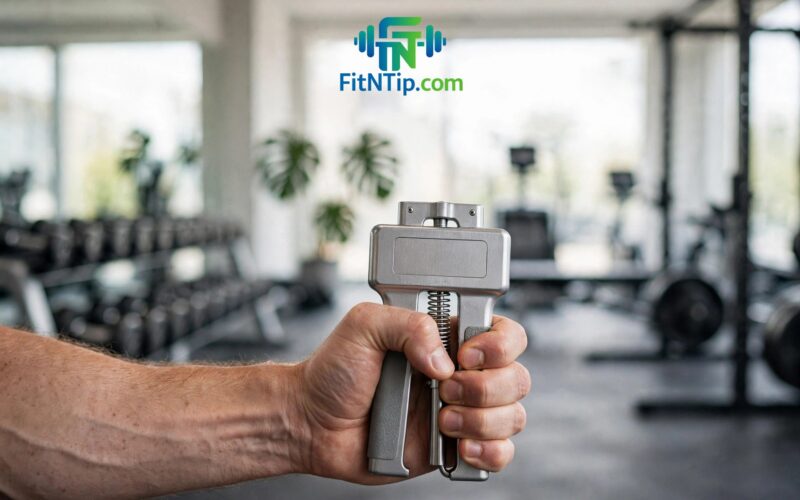
Grip strength is the maximum force your hand can squeeze, usually measured with a hand dynamometer — a device you hold and squeeze as hard as you can. The result is a single number in kilograms. The standard way to measure it, used in most of the big studies, is simple: sit down, hold your arm at your side with your elbow bent at about 90 degrees, squeeze as hard as you can for a few seconds, rest, and repeat. Three tries per hand is typical, and the best result counts.
That simplicity is the point. A VO2 max test needs a treadmill, a mask, and a lab. A grip test needs a device the size of a paperback and half a minute. It is why clinics use it as a quick screen for muscle weakness, and why researchers keep coming back to it: it is the cheapest strength measurement that still predicts something real.
What it measures is not really your hand. Your grip is the visible end of a chain — forearm muscles, the nerves driving them, and the general state of your muscle system. When researchers call it a marker of overall muscle strength, they mean that a person with a strong grip usually also has stronger legs, a stronger back, and better physical function overall.
It is a proxy, and like all proxies it is imperfect: a rock climber has a strong grip from practice, and a person with arthritis in one hand may score low while the rest of their body is fine. The studies below are about populations, not about any one person’s hand. Grip strength is one part of functional fitness — the strength that shows up in daily life, from carrying groceries to opening jars.
It is also worth saying what grip strength is not. It is not a diagnosis. Scoring below a threshold does not mean you have a disease, and scoring above one does not mean you are healthy. The thresholds in this article come from sarcopenia research — the study of age-related muscle loss — where low grip is the first signal that prompts further checks, not the final word.
Why It Predicts How Long You Live
The reason grip strength keeps appearing in longevity discussions is not one study. It is three large, independent lines of evidence that all point the same way and — unusually — agree on the size of the effect.
The first is the PURE study, published in The Lancet in 2015. It measured grip strength in 139,691 adults aged 35 to 70 across 17 countries at every income level, then followed them for a median of 4.0 years, during which 3,379 people died. After adjusting for age, sex, physical activity, smoking, and other factors, each 5 kg lower grip strength was associated with a 16% higher risk of death from any cause (hazard ratio 1.16), a 17% higher risk of cardiovascular death (1.17), and a 17% higher risk of non-cardiovascular death (1.17). The links with heart attack (1.07) and stroke (1.09) were smaller but still present.
The finding that drew the most attention: grip strength predicted death more strongly than systolic blood pressure did.
The second is UK Biobank, published in the BMJ in 2018. It is bigger — 502,293 adults aged 40 to 69, followed for a mean of 7.1 years, with 13,322 deaths.
Per 5 kg lower grip, the risk of death from any cause was 20% higher in women (hazard ratio 1.20) and 16% higher in men (1.16). The strongest link of all was with respiratory death — 31% higher in women and 24% higher in men per 5 kg — followed by cardiovascular death (19% and 22%). Cancer deaths were also linked, though more weakly (17% in women, 10% in men), and prostate cancer showed no significant link.
The third is a meta-analysis that pooled the field. Wu and colleagues (2017) combined 42 prospective cohort studies covering 3,002,203 people. Per 5 kg lower grip, the risk of death from any cause was again 16% higher (hazard ratio 1.16), cardiovascular disease 21% higher (1.21), stroke 9% higher (1.09), and coronary heart disease 7% higher (1.07). Cancer showed no significant link (1.01).
Comparing the weakest grip group with the strongest, the risk of death was 41% higher (hazard ratio 1.41) and the risk of cardiovascular disease 63% higher (1.63). The relationship was linear up to a grip of 56 kg — below that, every kilogram seemed to matter about equally.
A second meta-analysis, by García-Hermoso and colleagues (2018), looked at it from the other direction: 38 studies with 1,907,580 participants and 63,087 deaths. People with higher handgrip strength had a 31% lower risk of death from any cause (hazard ratio 0.69) than people with lower strength — slightly stronger in women (0.60, a 40% lower risk) than in men (0.69).
| Study | Who was studied | What it found | What it does NOT prove |
|---|---|---|---|
| Leong et al. 2015, PURE (The Lancet) | 139,691 adults aged 35–70 in 17 countries; median 4.0 years follow-up; 3,379 deaths | Each 5 kg lower grip: 16% higher all-cause mortality (HR 1.16), 17% higher cardiovascular mortality (1.17); grip predicted death more strongly than systolic blood pressure | That grip causes the risk — the study is observational |
| Celis-Morales et al. 2018, UK Biobank (BMJ) | 502,293 adults aged 40–69; mean 7.1 years follow-up; 13,322 deaths | Each 5 kg lower grip: all-cause mortality 20% higher in women (HR 1.20) and 16% higher in men (1.16); respiratory mortality 1.31 / 1.24 | That the link is the same for every cause — prostate cancer showed no link |
| Wu et al. 2017 (meta-analysis, 42 studies) | 3,002,203 people in community settings | Each 5 kg lower grip: 16% higher all-cause mortality (HR 1.16); weakest vs strongest group: 41% higher mortality (1.41), 63% higher cardiovascular disease (1.63) | That cancer risk follows grip — the cancer link was not significant (1.01) |
| García-Hermoso et al. 2018 (meta-analysis, 38 studies) | 1,907,580 people; 63,087 deaths | Higher handgrip strength: 31% lower risk of death (HR 0.69); women 0.60, men 0.69 | That strength training by itself produces this gap — the comparison is between naturally stronger and weaker people |
Three patterns run through these studies:
- The same number keeps appearing. Three independent sources — PURE, UK Biobank, and the Wu meta-analysis — all land on 1.16 per 5 kg. That kind of agreement across different countries, ages, and methods is rare in this field, and it is the main reason grip strength is taken seriously as a marker.
- The gap is biggest at the bottom. The weakest group carries most of the excess risk. Going from weak to average matters far more than going from average to strong — the same shape as the VO2 max evidence.
- All of this evidence is observational. These studies measured people’s grip and then watched what happened. They show that weaker people die sooner. They do not show that weakening grip causes death, or that strengthening it prevents it. Illness itself lowers both grip and survival, so part of the link is reverse causation — sick people grip less hard. The studies adjust for known illness and still find the link, and they drop deaths in the first years of follow-up to reduce this problem, but adjustment cannot remove it entirely.
There is also an honest negative worth recording. The PURE study found no association between grip strength and diabetes, admission for pneumonia or COPD, falls, or fractures. Grip tracks mortality and cardiovascular events; it does not track everything. A marker that predicted all outcomes equally would be suspicious. This one has a shape, and the shape has limits.
What Counts as Weak — and What Counts as Normal
Grip strength falls with age, and men grip harder than women at every age. The best picture of that pattern comes from Dodds and colleagues (2014), who pooled 60,803 measurements from 49,964 people across 12 British studies and drew centile curves from age 4 to 90. Grip rises to a peak in early adulthood, holds roughly steady through midlife, and then declines from around age 50 onwards.
The peak median grip was 51 kg for men (between ages 29 and 39) and 31 kg for women (between ages 26 and 42). By age 80, weak grip — defined as at least 2.5 standard deviations below the peak average — affected 23% of men and 27% of women.
That decline is normal ageing, not a personal failure.
The question the clinics ask is different: at what point does low grip signal a problem worth checking? The European sarcopenia consensus, EWGSOP2 (2019), set the line at grip below 27 kg for men or 16 kg for women. Below that, a person has “probable sarcopenia” — low muscle strength that should prompt a check of muscle mass and physical performance. Other frameworks draw the line nearby but not identically: the Asian Working Group (AWGS 2019) uses 28 kg for men and 18 kg for women, and the US FNIH criteria use 26 kg and 16 kg. A large German cohort of more than 205,000 adults derived its own cut-offs of 29 kg and 18 kg.
| Framework | Men | Women | What it means |
|---|---|---|---|
| EWGSOP2 (Europe, 2019) | Below 27 kg | Below 16 kg | Low muscle strength; “probable sarcopenia” — prompts further checks |
| AWGS 2019 (Asia) | Below 28 kg | Below 18 kg | Low muscle strength under the Asian consensus |
| FNIH (US) | Below 26 kg | Below 16 kg | Weakness threshold used in US sarcopenia research |
| German NAKO cohort | Below 29 kg | Below 18 kg | Cut-offs derived from 205,000+ German adults — populations differ |
The differences between these numbers are the point, not a problem. A cut-off is a convention chosen to separate populations, not a biological cliff. Nothing changes at 26.9 versus 27.1 kg. What matters is the direction: well below the line deserves a conversation with a clinician; near the line is a reason to pay attention to strength, not a reason to panic.
Two cautions belong with any number you measure yourself. First, dynamometers differ. A reading can shift by several kilograms between devices, handle positions, and protocols — so a home or gym reading is an approximation, not a clinical result. Second, grip is one hand’s squeeze. Arthritis, a recent injury, or a nerve problem in one hand can lower the number without saying anything about the rest of your body. Compare hands, and if one is far below the other, that asymmetry itself is worth mentioning to a clinician.
Grip Strength and VO2 Max: Two Numbers, One Picture
The earlier post in this series covered VO2 max, the aerobic ceiling. Grip strength is its counterpart: the strength floor. One measures the heart and lungs; the other measures muscle. Together they cover the two systems that decline with age and predict survival — cardiorespiratory fitness and muscular strength — and the World Health Organization’s 2020 guidelines recommend both kinds of activity: 150–300 minutes of moderate aerobic activity (or 75–150 minutes vigorous) per week, plus muscle-strengthening on 2 or more days per week.
The two numbers behave the same way in the research. Both show the steepest benefit at the bottom of the scale. Both are observational predictors, not proven levers. And both are cheap to track over time, which is their real practical value: a number that moves slowly in the wrong direction over years is a signal worth noticing, whether it is your 5 km time getting slower or your grip slipping a few kilograms.
If you read the VO2 Max post, think of this one as the second half of the same check-up: one number for the engine, one for the chassis.
Can You Improve It? What Training Studies Show
This is where honesty matters most, because the gap between “linked to living longer” and “training makes you live longer” is exactly where bad advice lives. No trial has shown that raising grip strength extends life. What trials have shown is narrower: resistance training improves grip strength, by a modest amount.
The most recent synthesis, a 2025 meta-analysis in Aging Clinical and Experimental Research, pooled 24 randomised controlled trials with 951 adults aged 60 and over diagnosed with sarcopenia. Resistance training significantly improved handgrip strength, gait speed, knee extension strength, and the timed up-and-go and sit-to-stand tests. But the authors added a qualification that matters: the grip improvements did not exceed the minimal important difference thresholds — the smallest change that would matter to a person’s daily life. Statistically real, clinically modest.
Their modelling suggested an optimal dose of around 1,220 MET-minutes per week of resistance training for grip strength, with a minimal effective dose of around 600 MET-minutes per week for gait speed — but those are modelled estimates from trials, not prescriptions for an individual.
The WHO’s 2020 guidelines give the general direction, not a personal programme: muscle-strengthening activities on 2 or more days per week, alongside the aerobic minutes above. The home-workout guide on this site describes the same pattern in practical terms — compound movements, carries, hangs, and pulls that load the hands as part of whole-body strength work.
What the training evidence does not support is grip-only training as a longevity strategy. Squeezing a grip trainer will strengthen your grip, and a stronger grip is a reasonable goal on its own terms. But the mortality link runs through overall muscle strength and function, not through the hand. The honest reading of the trials is that whole-body resistance training improves grip as one part of improving overall strength — and overall strength is what the observational studies are actually tracking.
How to Test Yours — and How Not to Read the Result
If you want a number, the reliable way is a hand dynamometer — at a gym, a clinic, or a physiotherapist’s office. The standard protocol is the one most studies used: sit with your back supported, hold the dynamometer at your side with your elbow bent at about 90 degrees, squeeze as hard as you can for a few seconds, rest, and repeat three times per hand. The best of the three counts. Warm up first, and do not test through pain.
A few rules keep the number honest:
- Test both hands. The studies generally use the best hand, or the average of both. A big gap between hands is information in itself.
- Use the same device and protocol each time. Different dynamometers give different readings, so a number only means something compared with your own previous number on the same device.
- Do not test once and decide. Grip varies by day, by time of day, and by fatigue. One low reading is noise; a trend over months is signal.
- Do not treat the cut-off as a diagnosis. Below 27 kg (men) or 16 kg (women) is the sarcopenia screening line — a reason to talk to a clinician, not a verdict on your health.
And the result to avoid: turning a screening number into a daily obsession. Grip strength is useful precisely because it changes slowly. Checking it once or twice a year, alongside the other things that matter — how far you can walk, how easily you climb stairs, how you sleep — is the right cadence. Checking it every morning is not.
Myths vs Facts
| Myth | What the research actually says |
|---|---|
| A weak handshake means you will die young | No. Grip strength predicts risk across populations; it says nothing certain about any one person, and a single handshake is not a measurement |
| Grip strength is about your hands | No. It is a marker of overall muscle strength and function — the hand is just where it is easiest to measure |
| Training your grip alone will extend your life | No trial proves this. Resistance training improves grip modestly, but the mortality link runs through overall strength, not the hand |
| There is one “good” grip number for everyone | No. Grip peaks at 51 kg (men) and 31 kg (women) in young adulthood and falls with age; cut-offs differ by framework and population |
| A strong grip means you are healthy | Not on its own. Grip is one signal among many, and it showed no link with diabetes, falls, or fractures in the PURE study |
| Grip strength cannot be improved after 60 | Wrong. Trials in adults over 60 with sarcopenia showed significant grip improvements from resistance training — modest, but real |
Interesting Facts
- Three studies, one number: PURE, UK Biobank, and a 42-study meta-analysis all found the same figure — about 16% higher mortality per 5 kg lower grip. That level of agreement is unusual in health research.
- It beat blood pressure: in the PURE study, grip strength predicted death from any cause and from cardiovascular disease more strongly than systolic blood pressure did.
- The respiratory link is the strongest: in UK Biobank, each 5 kg lower grip was linked to 31% higher respiratory mortality in women — stronger than the link with heart disease.
- Weak grip is common by 80: by age 80, weak grip affected 23% of men and 27% of women in the British normative data.
- The number is linear up to 56 kg: the meta-analysis found the risk fell steadily with grip up to 56 kg — above that, the data thins out and the pattern is less clear.
- It is the cheapest vital sign in the room: a dynamometer costs a fraction of a blood test and the measurement takes about 30 seconds, which is why clinics use it as a screen.
Frequently Asked Questions
What Is a Good Grip Strength?
There is no single good number, because grip depends on age and sex. The peak medians in the British normative data are 51 kg for men (ages 29–39) and 31 kg for women (ages 26–42), falling steadily after midlife. The clinical line for low strength is below 27 kg for men or 16 kg for women (EWGSOP2). Above that line, and close to the typical range for your age, is the unremarkable place to be — which is the good place.
How Do I Measure Grip Strength at Home?
The reliable way needs a hand dynamometer, available at most gyms and clinics. Sit, elbow bent at about 90 degrees, squeeze as hard as you can for a few seconds, rest, and repeat three times per hand — the best result counts. Bathroom scales, jar lids, and hanging from a bar are not calibrated measurements, and there are no verified norms for them, so they cannot be compared with the study thresholds.
Does Grip Strength Really Predict How Long You Live?
It predicts risk, it does not determine fate. Across PURE, UK Biobank, and a meta-analysis of 3 million people, each 5 kg lower grip was linked to about 16% higher mortality. But all of that evidence is observational: weaker people die sooner, and illness itself lowers grip. No trial has shown that raising grip strength adds years.
Can I Improve My Grip Strength?
Yes, modestly. Trials in older adults with sarcopenia found resistance training significantly improved grip strength, though the gains were small and did not cross the threshold for a clinically meaningful difference. Whole-body strength training — the kind described in the WHO guidelines as muscle-strengthening on 2 or more days a week — is the evidence-backed route, not grip-only gadgets.
Is Grip Strength More Important Than VO2 Max?
Neither is more important; they measure different systems. VO2 max tracks the heart and lungs, grip tracks muscle strength and function, and both predict survival in large studies. If you track one number, track the one you can change and measure reliably — and if you can track both, they give a fuller picture than either alone.
Medical Disclaimer
This article is for general information only. It is not medical advice, and it is not a substitute for professional medical advice, diagnosis, or treatment. Grip strength cut-offs are population screening thresholds from sarcopenia research, not diagnoses for any individual. If your grip strength is low, falling quickly, or very different between hands, speak to a qualified clinician. Always consult a healthcare professional before starting a new exercise programme, especially if you have a medical condition. The author is a research writer, not a licensed medical clinician.
Sources
- Leong DP, Teo KK, Rangarajan S, et al. Prognostic Value of Grip Strength: Findings From the Prospective Urban Rural Epidemiology (PURE) Study. The Lancet. 2015;386(9990):266–273. DOI 10.1016/S0140-6736(14)62000-6. PubMed PMID 25982160
- Celis-Morales CA, Welsh P, Lyall DM, et al. Associations of Grip Strength With Cardiovascular, Respiratory, and Cancer Outcomes and All Cause Mortality: Prospective Cohort Study of Half a Million UK Biobank Participants. BMJ. 2018;361:k1651. DOI 10.1136/bmj.k1651. PMC5939721
- Wu Y, Wang W, Liu T, Zhang D. Association of Grip Strength With Risk of All-Cause Mortality, Cardiovascular Diseases, and Cancer in Community-Dwelling Populations: A Meta-Analysis of Prospective Cohort Studies. Journal of the American Medical Directors Association. 2017;18(6):551.e17–551.e35. DOI 10.1016/j.jamda.2017.03.011. PubMed PMID 28549705
- García-Hermoso A, Cavero-Redondo I, Ramírez-Vélez R, et al. Muscular Strength as a Predictor of All-Cause Mortality in an Apparently Healthy Population: A Systematic Review and Meta-Analysis of Data From Approximately 2 Million Men and Women. Archives of Physical Medicine and Rehabilitation. 2018;99(10):2100–2113.e5. DOI 10.1016/j.apmr.2018.01.008. PubMed PMID 29425700
- Dodds RM, Syddall HE, Cooper R, et al. Grip Strength Across the Life Course: Normative Data From Twelve British Studies. PLOS ONE. 2014;9(12):e113637. DOI 10.1371/journal.pone.0113637. PMC4256164
- Cruz-Jentoft AJ, Bahat G, Bauer J, et al. Sarcopenia: Revised European Consensus on Definition and Diagnosis. Age and Ageing. 2019;48(1):16–31. DOI 10.1093/ageing/afy169. PMC6322506
- Optimal Resistance Training Prescriptions to Improve Muscle Strength, Physical Function, and Muscle Mass in Older Adults Diagnosed With Sarcopenia: A Systematic Review and Meta-Analysis. Aging Clinical and Experimental Research. 2025;37(1):320. PubMed PMID 41212331
- Bull FC, Al-Ansari SS, Biddle S, et al. World Health Organization 2020 Guidelines on Physical Activity and Sedentary Behaviour. British Journal of Sports Medicine. 2020;54(24):1451–1462. WHO physical activity fact sheet
This article is for informational and educational purposes only. It does not constitute medical advice, diagnosis, or treatment. The information presented is researched from trusted sources including peer-reviewed scientific journals, CDC, NIH, WHO, and recognized health organizations. Always consult a qualified healthcare professional before making any changes to your diet, exercise routine, or health regimen.



that is fascinating connection. I heard about the grip thing a while ago, but your post and study is very informative. Cheers.